Your First Reef Snorkel: A Beginner's Guide to Gear, Buoyancy and Reef-Safe Technique
Snorkelling looks like the simplest thing in the world: face in the water, breathe, watch the fish. Then you get in, your mask fogs, your legs ache, and one careless flick of a fin lands on a coral head that took decades to grow. None of that means you are doing it wrong. It usually means your gear does not fit and nobody has shown you how to hover.
This guide covers what to sort out first, how to float without touching anything, how to get in and out of the water without drama, and the small habits that keep beginners clear of the reef.
Fit Comes Before Features: Choosing a Mask
A mask is only useful if it seals, and a seal depends on your face, not the price tag. Look for a low-volume mask with a soft silicone skirt and a tempered glass lens. Black silicone cuts glare, which matters on bright days over pale sand.
Test one in the shop without using the strap. Press the mask gently against your face, breathe in through your nose, and let go. If it stays put, the seal is right. If it lifts near your cheeks or eyebrows, try another shape. Once in the water, the strap should sit across the back of your head, not high over your ears, and no hair should be trapped under the skirt.
Fogging is easy to beat. Spit in the lens, rub it around, rinse briefly, or use a drop of diluted baby shampoo. Do that before you get in, not while you are hovering over coral with one hand on a rock.
Fins That Suit Snorkelling, Not Sprinting
Short, soft-bladed fins are easier to control and far less tiring for a beginner. Long stiff blades feel impressive and punish your ankles. In warm water, full-foot fins are fine; in the UK, an open heel with a pair of thin booties is warmer and easier to walk in over shingle.
Fins should be snug without curling your toes or rubbing your heel. Once you are swimming, the kick comes from your hips, knees mostly straight, with small quick movements rather than big bicycle strokes. Keep your legs close to the surface so you are not kicking up sediment or clipping the top of the reef. On rocks or a boat deck, do not walk forwards in fins — shuffle backwards or carry them until you are in the water.
Floating Without Touching the Reef
Your lungs are your buoyancy control. Breathe in and you rise; breathe out and you settle. Do both slowly. A snorkelling vest or buoyancy aid is a sensible choice for a first session in choppy or cold water, but it does not replace knowing where your body is in the water.
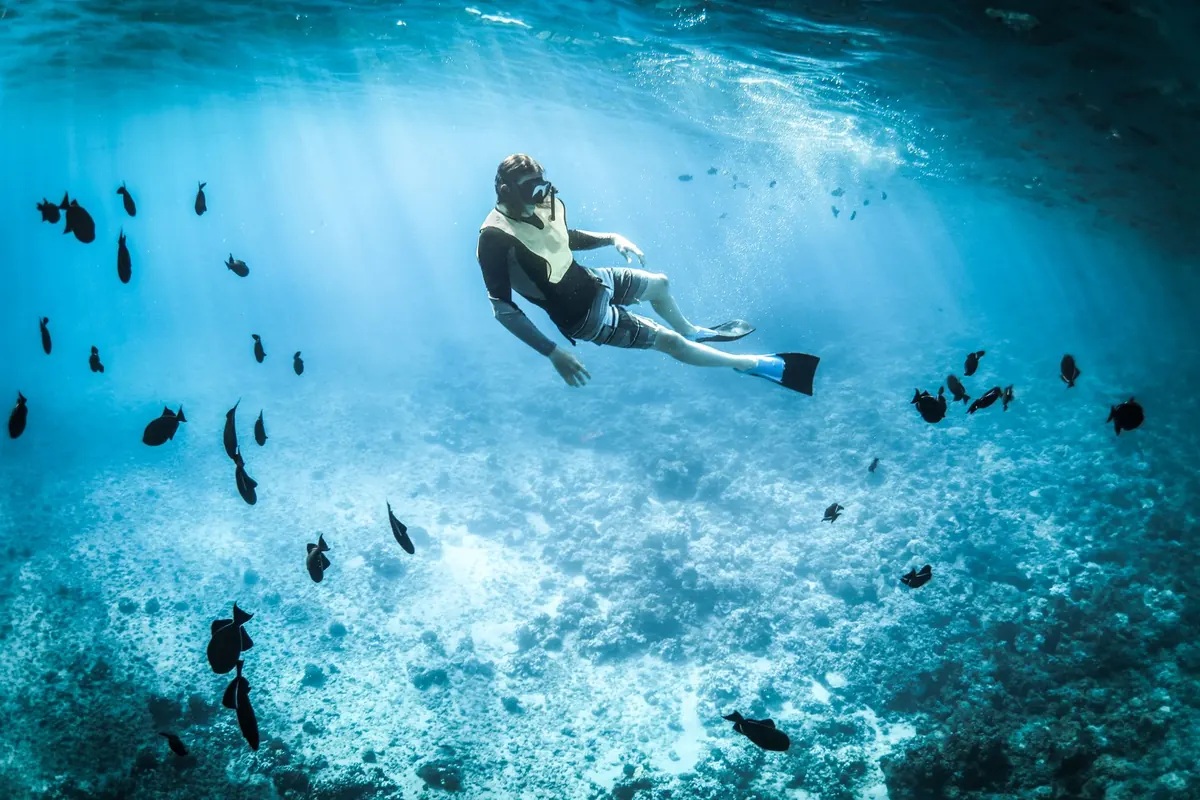
Float face down and horizontal, arms relaxed by your sides or one hand stretched forward. To stop and look at something, spread your arms and legs into a starfish shape — that kills your forward momentum without you having to stand. Turn your head before you change direction so you know what is behind your fins.
The most damaging habit is the fin downstroke. When you tread water upright above coral, your fins sweep down and snap branches. Stay flat, keep your legs behind you, and if you must stop, hover.
If you genuinely need to stand, find a patch of open sand and lower yourself gently. Even sand deserves a glance: flatfish, rays and garden eels all use it. Never grab coral to steady yourself, and never treat a pale or algae-covered colony as dead rock. It is not.
Getting In and Out
Sort yourself out on land first: mask on, defogged, snorkel attached, fins in your hand until the water is deep enough to swim.
- Shore entry. Pick a sandy gap and watch the waves for a few minutes so you know how the sets arrive. Walk in backwards or sideways where it is rocky, and shuffle rather than step.
- Put your fins on once you are waist deep — sit down in the shallows, or float and reach back. Then lie flat and swim out over sand before heading anywhere near structure.
- Boat entry. Use a giant stride from a high deck with one hand holding your mask, or sit on the side and roll in from a low one. Fins stay on for a giant stride; they come off for a ladder.
- Shore exit. Swim until your fins touch sand, then stand. Walk out facing the sea if there is any swell, and take your fins off in the shallows rather than on the reef flat.
- Boat exit. Fins off first and passed up, then climb. Keep your mask on until you are safely on deck.
Small Habits That Protect Coral
- Keep your hands clasped in front of you when they are not doing anything. Leave the gloves at home — they encourage grabbing.
- Give every animal two metres. No chasing, no feeding, no touching, no blocking a turtle's route to the surface.
- Swim around shallow coral rather than over it. If you have to cross a shallow flat, float high, arms in, small kicks.
- Take photographs, not souvenirs.
- Choose a mineral sunscreen with zinc oxide or titanium dioxide, applied before you get in, and cover up with a rash vest, leggings and a hat. Less product in the water, less burn on your back.
- Spend your first session in a pool or a sheltered sandy bay. Skill on sand transfers to the reef; panic over coral does not.
Cold Water, Sun and Safety
UK water is colder than most visitors expect, and a well-fitting wetsuit with a hood and booties beats a loose thicker one. Never snorkel alone. Go with a buddy, and tell someone on shore where you are heading and when you expect to be back. Check the tide and the forecast — currents around headlands run much harder than they look from the beach.
Enter slowly and let your breathing settle before you put your face in, because cold water shock on a first entry is real. Get out if you are shivering, cramping, or fighting the urge to breathe through the snorkel. If you have a heart or lung condition, asthma, epilepsy, or you are pregnant, speak to a doctor before you snorkel, and if you are unsure about your ability, book a session with a qualified instructor.
Your First Snorkel, Step by Step
Pick a calm day, a sandy entry and gentle swell. Get in, lie flat over sand and take ten slow breaths through the snorkel. Then practise three things: the starfish stop, clearing your mask, and a gentle duck dive to look at a shell. Only after that should you swim towards the reef, keeping a couple of metres of clear water beneath you.
Ten minutes drifting quietly over one coral head will show you more than an hour of finning around. Stay still, breathe slowly, and let the reef come to you.
Photo: Miles Hardacre / Pexels